

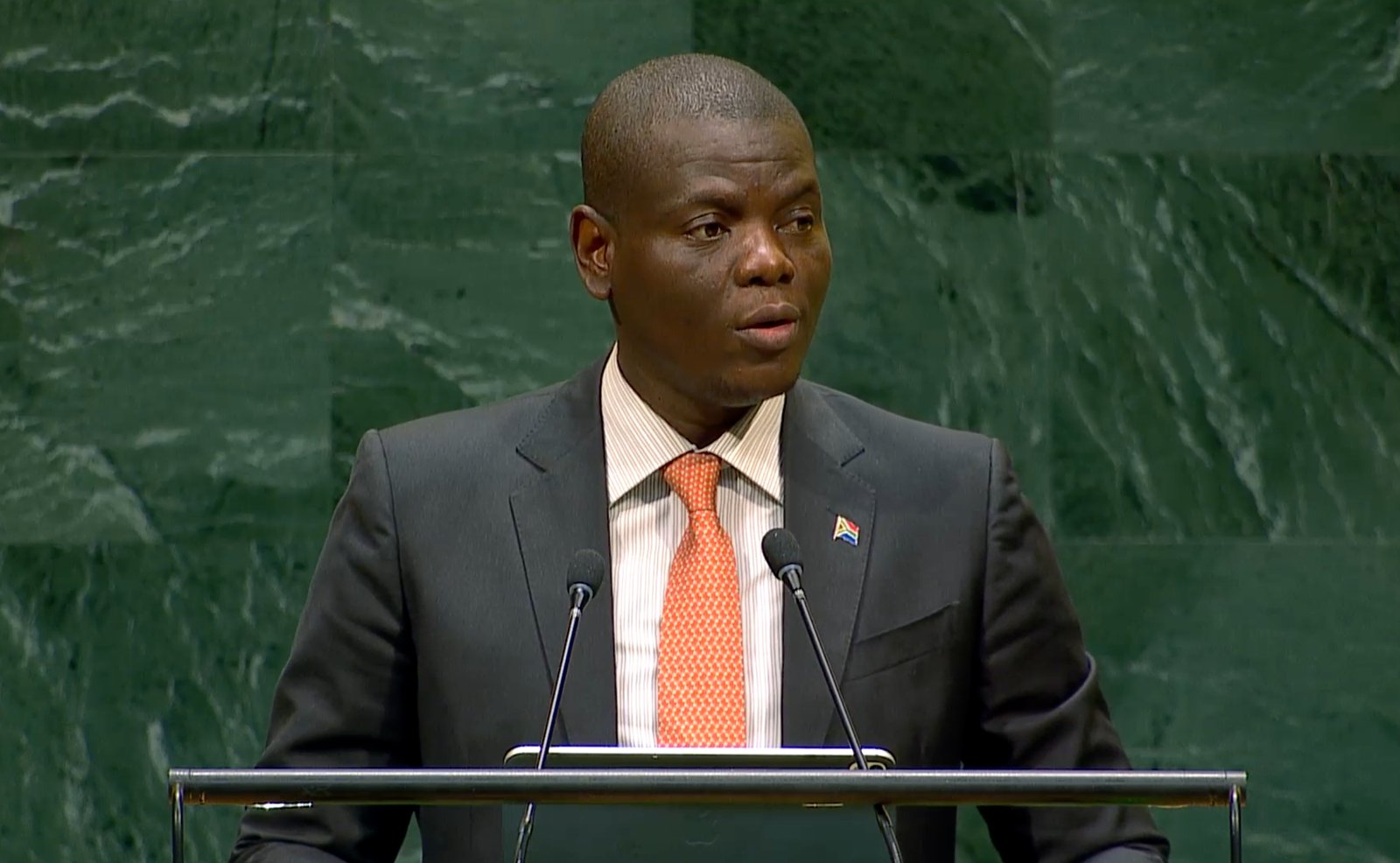
Ronald Ozzy Lamola, Minister for International Relations and Co-operation of South Africa, recalled that 60 years ago the UN adopted a resolution condemning apartheid as a crime against humanity. “The demise of apartheid freed the people of South Africa from racial segregation and slaughter, domination and deprivation, humiliation and exploitation”, he stated: “A glorious story that attests to what multilateralism can deliver.”
He noted that the promise of democracy and international cooperation “wanes when we cannot demonstrate that they can address inequality and insecurity.” “Compelled by our unenviable position as the world’s most unequal society, South Africa made inequality a key focus of our G20 Presidency in 2025,” he said.
Inequality means “the top 10 per cent own roughly 75 per cent of global wealth, while the bottom 50 per cent own only 2 per cent”. That, however, is not insurmountable.
Together with Brazil, Norway and Spain, he called on the Assembly to support establishment of an International Panel on Inequality.
Further, many Governments must choose “whether to meet the needs of their citizens or satisfy the expectations of creditors”. In the last year, African countries spent roughly as much “servicing debt as is needed to close our infrastructure financing gap.”
On climate, he recalled that in the last year, 2 million people in the South African Development Community suffered the debilitating impact of floods, cyclones, wildfires, and disease outbreaks.
With responses “severely constrained by a climate finance architecture stacked against developing nations”, he called for global action on disaster resilience and predictable financing for a just energy transition.
Noting Africa has the world’s largest reserves of critical minerals, he accented that these “can help bridge the gap between wealthy and poor nations.”
Meanwhile, “ending hunger and expanding access to safe water and sanitation would require no more than 5 per cent of the $2.9 trillion spent on arms”.
Further, with Africa home to nearly one fifth of the world’s population and more than a quarter of UN Member States, “permanent seats for Africa in the Security Council are long overdue”.